
Selecting reliable PVC Union suppliers requires more than comparing unit prices. Global buyers must examine material quality, dimensional consistency, pressure ratings, production experience, and export capability. A dependable supplier should provide clear technical data, traceable batches, and practical support before installation. Small details matter. A rough thread can delay an entire project.
Thermoplastic piping specialist Dr. Bruce Hollands once stated, “A fitting is only as reliable as its sealing surface and installation discipline.” This principle remains highly relevant when evaluating a Pvc Union for water treatment, irrigation, industrial processing, or commercial plumbing. The best suppliers understand that unions must disconnect easily while maintaining stable, leak-resistant connections. They also recognize differences between PVC-U, CPVC, solvent-weld, threaded, and gasketed designs.
This guide reviews leading Pvc Union suppliers for global buyers in 2026. It considers manufacturing standards, product range, customization, quality controls, delivery performance, and after-sales communication. Certificates can help, but they do not replace factory inspection or sample testing. That is easy to forget.
Some suppliers may appear competitive until packaging damage, inconsistent molding, or weak documentation increases total cost. Buyers should request drawings, pressure data, sample units, and installation guidance before placing large orders. No ranking is perfect. Regional availability, application conditions, and changing logistics can alter the final decision. A supplier trusted for irrigation may not suit chemical service. Careful comparison remains necessary, especially when a low quotation hides important limitations.
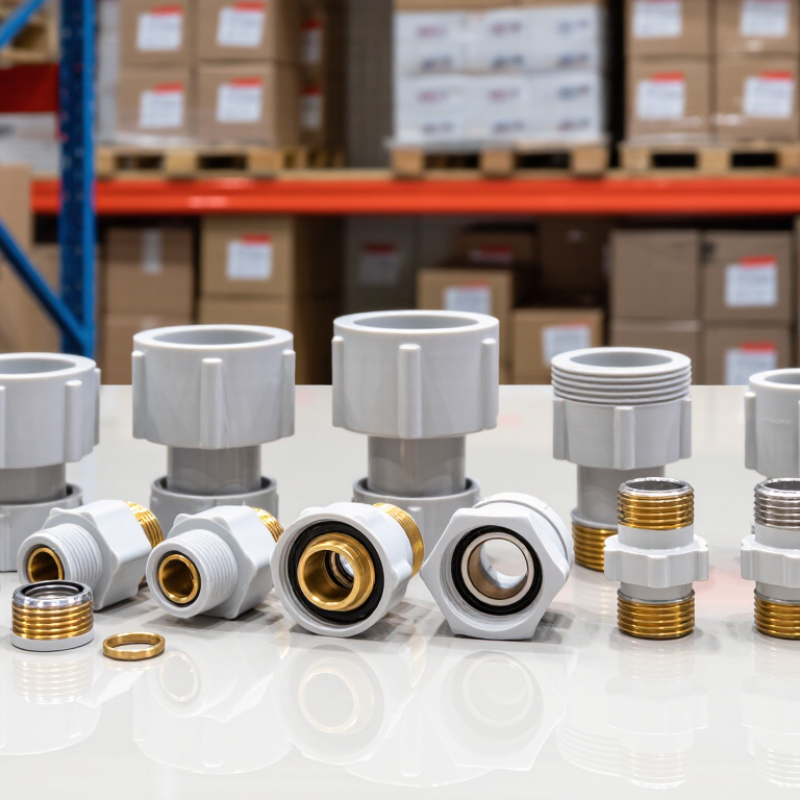
PVC unions are detachable pipe fittings designed to connect and disconnect PVC lines without cutting the pipe. Each union usually has three parts: two end connections and a central nut. The seal depends on an O-ring or a precisely matched sealing face. This structure helps maintenance teams remove pumps, filters, valves, and meters quickly. It also reduces repair time in crowded mechanical rooms.
Common types include socket unions, threaded unions, and true unions. Socket models use solvent cement and create compact, permanent end connections. Threaded models suit equipment with female or male threaded ports, but excessive tightening can damage plastic threads. True unions combine a removable center section with solvent-welded or threaded ends.
During selection, verify pipe size, pressure rating, temperature range, sealing material, and fluid compatibility. A union rated for water may perform poorly with aggressive chemicals.
Global applications include irrigation systems, swimming pools, aquaculture, drinking-water treatment, and industrial dosing equipment. In a treatment plant, operators may isolate a filter and remove it within minutes. In greenhouse irrigation, unions support seasonal flushing and line changes.
Installation experience shows that alignment matters as much as fitting quality. Forced pipe alignment can stress the union and create slow leaks. Even experienced buyers miss this detail. Check dimensions carefully. Standards and test documents should match the destination market, yet paperwork alone cannot replace a visual inspection. Slight assembly errors remain possible. A pressure test after installation is still a sensible step.
Evaluating PVC Union Suppliers for Global Buyers
PVC unions support maintenance, inspection, and secure pipe connections. Their quality affects downtime, leakage risk, and replacement costs. Field inspections often reveal problems hidden by polished catalogs. Start with pressure ratings, temperature limits, connection sizes, and actual fluid compatibility. A supplier should provide technical drawings, material specifications, and batch traceability. Photos alone are insufficient.
Reliable suppliers explain how they test body strength, sealing performance, and thread accuracy. Ask for recent inspection records, sample reports, and documented quality procedures. Independent laboratory results can strengthen confidence, especially for high-pressure systems. Check whether production follows recognized international standards and whether certificates match the shipped product. Small details matter. Incorrect dimensions can delay an entire installation.
Communication also deserves careful evaluation. Suppliers should answer technical questions directly and disclose tolerances, lead times, packaging methods, and warranty boundaries. Request samples before placing large orders. Compare total cost, not only unit price, because weak seals may create expensive maintenance work. No checklist is perfect. A supplier may pass document reviews but perform poorly during delivery or after-sales support. Trial orders, factory audits, and clear written agreements provide more practical evidence. I would not rely on promises without measurable records.
The 2026 ranking of leading PVC union suppliers focuses on measurable supply performance, not advertising visibility. Grand View Research valued the global PVC market at approximately USD 44 billion in 2023, with continued growth expected through 2030. This expansion increases demand for reliable unions in water treatment, irrigation, and industrial piping systems.
Tier-one suppliers typically combine stable resin sourcing, automated injection molding, and documented pressure testing. Their products should meet relevant ISO, ASTM, or equivalent regional standards. We assess dimensional consistency, thread accuracy, sealing performance, production capacity, export experience, and delivery reliability. A strong supplier also provides traceable batch records and clear technical drawings. Small details matter.
Mid-ranked suppliers may offer competitive pricing and flexible customization, but their quality records can be less consistent. Some publish limited test data. That is a concern. A 2024 market analysis from Fortune Business Insights projected sustained growth in the PVC pipes sector, driven by infrastructure upgrades and water-management projects. However, market reports usually group unions with broader PVC components, so direct supplier comparisons remain imperfect.
For global buyers, the highest-ranked suppliers should demonstrate repeatable pressure performance, controlled wall thickness, and practical after-sales support. Buyers should request samples, inspection reports, and recent production references before placing large orders. Public rankings are useful, but they cannot replace verification. Supplier capacity figures may also change quickly with energy costs, freight conditions, and regional demand.
The chart presents a buyer-focused 2026 evaluation framework for PVC union suppliers. Scores are normalized from 0 to 100 across product range, international certification coverage, export readiness, delivery reliability, and technical support. Higher scores indicate stronger suitability for global procurement.
Regional strength matters when sourcing PVC unions, especially for water, irrigation, and industrial piping projects. UN Comtrade data under HS 391740 shows strong global trade in plastic pipe fittings, although the code includes more than PVC unions. East Asian suppliers benefit from dense molding networks, container access, and broad size availability. Their advantage is usually production flexibility, not always the shortest total lead time.
European suppliers often compete through technical documentation, traceability, and tighter conformity processes. PlasticsEurope reported European plastics production at about 54.6 million tonnes in 2023, despite an annual decline. That contraction deserves attention. Capacity is not the same as dependable availability. North American producers can support regional projects with shorter inland routes and easier communication across time zones. Gulf-based exporters offer strong polymer access and efficient sea links toward Africa, South Asia, and the Middle East.
ITC Trade Map data can help buyers compare export value, destination concentration, and year-on-year changes for HS 391740. Check shipment records, not just catalog claims. A supplier with low prices may still create delays through weak packing or incomplete certificates. Ask for pressure-test records, dimensional tolerances, resin specifications, and photographs of pallet protection. Small details matter. Sometimes, painfully. Regional logistics can also shift quickly because freight rates, port congestion, and currency movements remain difficult to predict.
2026 Top PVC Union Suppliers for Global Buyers
How Global Buyers Can Select the Right PVC Union Supplier
Selecting a PVC union supplier requires more than comparing unit prices. Check the supplier’s manufacturing experience, quality system, and product testing records. A reliable supplier should provide pressure ratings, temperature limits, dimensional drawings, and material specifications.
Ask how the supplier controls resin batches and additives. Traceable production records can reveal problems before they reach your installation site. Request samples with the same specifications as your planned order. Inspect thread fit, sealing surfaces, socket depth, and body finish. Small defects often become leaks after repeated maintenance.
Supplier audits also matter. Review equipment, inspection stations, packaging methods, and staff training. Confirm whether production can support your required volume without changing quality. Discuss lead times, replacement parts, export documents, and communication procedures in writing. Total cost includes rejected parts, delays, labor, and future service.
Do not rely on polished certificates alone. Verify test reports and ask whether an independent laboratory can confirm critical results. A supplier may offer an attractive price but lack stable process control. That risk is easy to underestimate. I would also compare two or three trial batches, although this takes more time. The best choice may not be the cheapest supplier. It should be the supplier whose evidence remains consistent under practical review.
Anonymous supplier-selection matrix for comparing PVC union manufacturers and exporters without relying on company names or brand claims.
| Evaluation Dimension | Realistic Buyer Benchmark | Documents or Data to Request | Importance | Recommended Buyer Action |
|---|---|---|---|---|
| Product Material | Virgin, pressure-rated PVC-U compound should be clearly identified. Recycled content may be acceptable for non-pressure applications when permitted by the project specification. | Material declaration, technical datasheet, compound specification, and a statement identifying whether the fitting is intended for pressure or non-pressure service. | High | Reject suppliers that cannot define the resin type, application class, or traceability of the material. |
| Applicable Standards | Select products according to the destination market and application. Common references include ASTM D2466 for Schedule 40 PVC fittings, ASTM D2467 for Schedule 80 PVC fittings, and ISO 1452 for metric PVC-U pressure systems. | Standard declaration, conformity statement, test reports, and the exact edition of the standard used for production and testing. | High | Match the supplier’s standard to the project drawings, local plumbing code, and importing-country requirements. |
| Size and Connection Options | A globally useful range normally includes inch or metric sizes, with socket, threaded, or mixed-end configurations depending on the market. Size availability must be confirmed by product series. | Dimension chart, end-connection drawings, thread specification, tolerances, and a complete size list for unions, O-rings, nuts, and body components. | High | Confirm compatibility with the pipe outside diameter, thread form, joining method, and installation tools used at the job site. |
| Pressure Rating | Pressure capacity varies by nominal size, temperature, material schedule, connection type, and design standard. It must not be judged from size alone. | Pressure-rating table by size and temperature, hydrostatic test method, design basis, and maximum allowable operating pressure. | High | Compare the supplier’s pressure data with the system’s design pressure, surge conditions, fluid temperature, and safety factor. |
| Temperature and Chemical Resistance | PVC is generally selected for ambient and moderately warm fluid service, but pressure capability decreases as temperature rises. Chemical suitability depends on the exact fluid, concentration, temperature, and exposure time. | Temperature derating chart, chemical-resistance guide, application limitations, and compatibility information for the sealing material. | High | Obtain written confirmation for acids, alkalis, salts, solvents, potable water, wastewater, or other specified media. |
| Sealing System | The union should use a properly dimensioned sealing element, commonly an elastomeric O-ring or gasket selected for the service medium and temperature. | Seal material, hardness range, cross-section dimensions, replacement-part availability, and leakage-test results. | High | Verify that the seal is compatible with the transported fluid and that replacement seals can be purchased separately. |
| Dimensional Accuracy | Consistent socket depth, wall thickness, thread dimensions, roundness, and union-face alignment are essential for leak-free assembly and interchangeability. | Approved drawings, inspection plans, dimensional inspection records, calibrated measuring-equipment records, and sample inspection reports. | High | Require pre-production samples or first-article approval for private-label, custom, or high-volume projects. |
| Jointing and Installation Method | Socket unions may require solvent cement suitable for PVC, while threaded or mixed-end designs require the correct thread sealant and installation torque. | Installation instructions, approved cement or sealant requirements, tightening guidance, and disassembly/reassembly procedure. | Medium | Check that the supplier’s instructions match the installer’s tools, joining materials, and local construction practice. |
| Potable-Water Suitability | A general PVC fitting should not automatically be treated as suitable for drinking-water contact. The complete product and sealing components require the relevant approval for the target market. | Valid potable-water certification, scope of approval, test laboratory details, material formulation records, and expiry or renewal information where applicable. | High | Confirm that the approval covers the exact size, material, seal, and intended drinking-water application. |
| Factory Quality Management | A documented quality system should control incoming resin, molding parameters, dimensional inspection, pressure testing, lot identification, and nonconforming products. | Quality-management certificate, process-control plan, inspection checklist, corrective-action records, and production-lot traceability procedure. | High | Audit the factory or use an independent inspection agency before the first large shipment. |
| Leakage and Hydrostatic Testing | Testing should be performed according to the applicable product standard or approved project specification, with test pressure, duration, sample quantity, and acceptance criteria documented. | Batch test report, test equipment calibration certificate, sampling plan, and product-lot reference. | High | Require test records linked to the shipment rather than relying only on a general catalogue statement. |
| Production Capacity and Lead Time | Capacity should be evaluated by the required size mix, tooling availability, production schedule, quality-inspection time, and shipping window—not only by a stated monthly output. | Capacity statement, production schedule, tooling list, sample lead time, mass-production lead time, and historical on-time delivery data. | Medium | Separate sample lead time from repeat-order lead time and include inspection and export-document preparation in the schedule. |
| Minimum Order Quantity and Customization | MOQ commonly depends on size, color, packaging, tooling, printing, and private-label requirements. Standard products usually involve less risk than newly tooled designs. | MOQ by size, tooling quotation, mold ownership terms, packaging options, color limits, and change-control procedure. | Medium | Compare total landed cost at the actual order quantity, including tooling amortization and customized packaging. |
| Packaging and Export Readiness | Packaging should prevent thread damage, deformation, contamination, and mixed-size errors during container handling and long-distance transport. | Packaging specification, carton dimensions, pallet configuration, loading photographs, barcode or lot-label format, and export packing list. | Medium | Approve a packing sample and confirm container loading quantities before placing the production order. |
| Traceability and After-Sales Support | Each shipment should be traceable to a production lot, inspection record, material batch, and responsible production date. | Lot-code format, certificate of conformity, complaint-response procedure, warranty terms, spare-seal policy, and replacement process. | Medium | Test the supplier’s response time with a technical question and request a written warranty before contracting. |
| Total Landed Cost | The meaningful comparison is product price plus tooling, packaging, inspection, freight, insurance, import duty, taxes, leakage risk, and replacement cost. | Incoterm-based quotation, HS-code proposal, carton and pallet data, freight assumptions, payment terms, and defect-replacement policy. | High | Compare at least three qualified quotations using the same specification, quantity, delivery term, and inspection requirement. |
| Environmental and Compliance Information | Buyers should assess restricted substances, production waste handling, packaging materials, and any applicable environmental declarations required by the destination market. | Restricted-substance declaration, packaging declaration, waste-management statement, environmental certificates, and regulatory compliance documents. | Standard | Include environmental documentation in the supplier approval checklist instead of evaluating sustainability only from marketing claims. |
Buyer note: Pressure ratings, temperature limits, dimensions, certifications, and chemical compatibility are product-specific. Always verify the current technical datasheet, applicable standard, test report, and destination-market regulations for the exact PVC union configuration before purchase.
The assessment focuses on supply performance, not advertising visibility. Key factors include dimensions, thread accuracy, sealing, capacity, exports, and delivery reliability.
Request technical drawings, pressure-test records, resin specifications, and batch records. Evidence matters more than polished catalog pages.
Pressure tests help confirm sealing performance and product consistency. Buyers should review recent records, not only general quality claims.
East Asian suppliers often provide broad sizes and flexible molding capacity. European suppliers often emphasize traceability and conformity documents. North American suppliers may offer shorter inland routes. Gulf exporters can support sea links toward nearby regions.
Trade data can show export value, destination concentration, and yearly changes. However, HS 391740 includes more than PVC unions. Comparisons are imperfect.
Request samples, inspection reports, and recent production references. Check wall thickness, thread fit, sealing, pallet protection, and pressure performance.
Weak packing, incomplete certificates, or poor coordination can delay shipments. A low unit price is not always a low project cost.
No. Energy costs, freight conditions, and regional demand can change capacity quickly. Capacity is not dependable availability.
No. Rankings can narrow the search, but direct verification remains necessary. That is imperfect, but practical.
This guide presents a practical overview of the 2026 PVC union supply market for global buyers. It explains what a Pvc Union is, how its threaded, solvent-weld, and multi-connection designs differ, and where these fittings are commonly used, including water treatment, irrigation, industrial piping, agriculture, and chemical handling systems. The article also outlines the key factors for evaluating suppliers, such as material quality, dimensional consistency, pressure performance, production capacity, certifications, customization options, quality control, packaging, and delivery reliability.
A comparative ranking framework highlights leading suppliers according to product range, manufacturing capabilities, regional supply strengths, export experience, and customer support rather than brand reputation alone. It also examines how logistics networks, regional compliance knowledge, and inventory availability affect international purchasing. Finally, global buyers receive guidance on matching supplier capabilities with project requirements, assessing total cost, verifying technical documentation, requesting samples, and establishing clear communication and after-sales support before placing long-term orders.
