
+86-13534590764 [email protected] Foshan, Guangdong, China

How to Choose PVC Pipe and Fittings for Global Projects?

Time:2026-10-28 Author:Henry
0%

Choosing Pvc Pipe And Fittings for global projects requires more than comparing prices or wall thickness. A pipe crossing a humid coastal site faces different risks from one buried beneath frozen soil. Temperature, pressure, soil chemistry, ultraviolet exposure, installation skills, and local standards all influence long-term performance. Small details matter. A poorly supported elbow can create stress concentrations, while an unsuitable solvent cement may weaken a joint.

Market reports show why this decision deserves careful analysis. Grand View Research estimates continued growth in the global PVC pipes market through 2030, supported by water infrastructure, construction, and irrigation demand. The United Nations World Water Development Report 2023 states that approximately 2.2 billion people lacked safely managed drinking water in 2022. These figures suggest expanding infrastructure needs, but forecasts differ between research firms. They should guide planning, not replace engineering judgment.

Tony Radoszewski, former president and CEO of the Plastics Pipe Institute, has stated, “The application should drive the material choice.” That principle also applies to fittings. Engineers should verify pressure ratings, dimensional compatibility, fire requirements, drinking-water approvals, and standards such as ISO 1452, ASTM D1784, and ASTM D2466. In practical procurement, a reliable supplier should provide traceable resin information, test certificates, installation guidance, and batch records. Certifications alone are not enough. Site training still matters. A careful specification may feel slower, yet one overlooked transition fitting can delay an entire project. No selection method is perfect. Conditions change, and assumptions deserve another review before shipment.
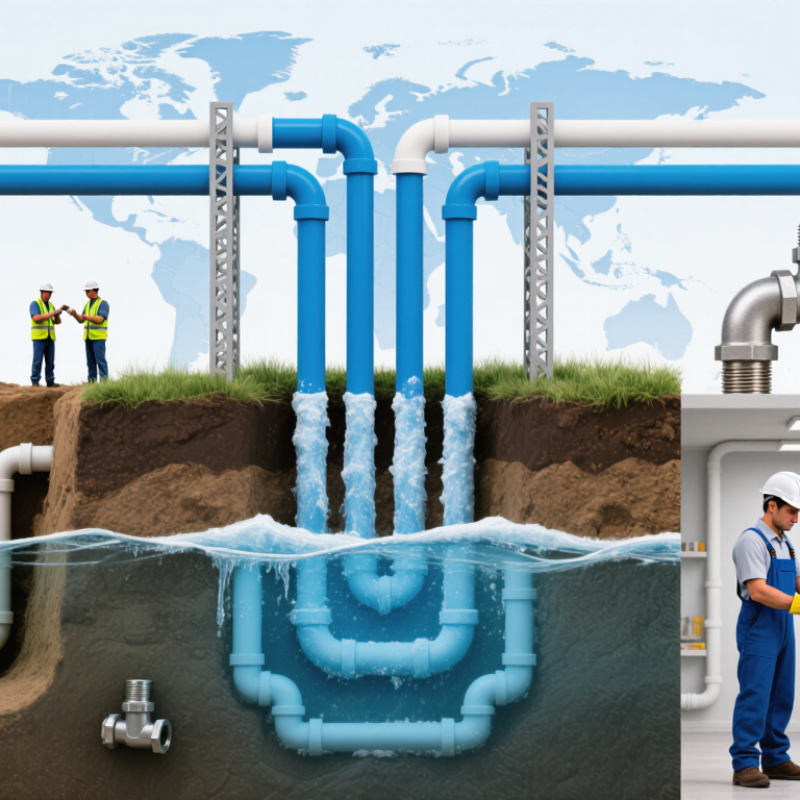
How to Choose PVC Pipe and Fittings for Global Projects?

Define Duty: Pressure, Temperature, Flow, Burial Depth, and UV Exposure

Choosing PVC pipe and fittings for a global project starts with defining the actual duty. Record working pressure, surge pressure, temperature range, flow rate, burial depth, and UV exposure. Pressure spikes matter more than a calm gauge reading. A pump starting suddenly can stress joints and fittings.

Temperature changes the pipe’s pressure capacity. Confirm the allowable rating at the highest operating temperature, not at room temperature. Flow calculations should include friction loss through valves, elbows, reducers, and long pipe runs. Oversizing may reduce velocity, but it can also increase material and installation costs. Do not size by guesswork.

Buried pipe needs protection from rock loads, traffic, groundwater, and soil movement. Specify suitable bedding and check deflection limits for the expected depth. Above ground, direct sunlight can weaken some PVC materials over time. Use approved UV protection or shielding where exposure is continuous. Fittings must match the pipe’s dimensions, pressure class, and joining method. Verify these details against current project standards and local requirements.

Field experience also matters. I have seen correct calculations fail after poor trench compaction or rushed joint preparation. Clean, dry surfaces and proper curing time are essential. A small installation mistake can become a hidden leak. Review the design with local engineers, because climate, soil, and inspection practices vary between regions. Some assumptions will be wrong. Check them before shipment.

How to Choose PVC Pipe and Fittings for Global Projects?

Define Duty: Pressure, Temperature, Flow, Burial Depth, and UV Exposure

The chart shows representative PVC-U pressure derating factors relative to the rated pressure at 20°C. As operating temperature rises, the allowable working pressure decreases. These values are suitable for preliminary comparison only; final selection must follow the applicable pipe standard, pressure class, installation method, and manufacturer’s certified data.

Pressure
Check operating pressure, surge pressure, and fitting pressure rating. The system design pressure should include transient events such as pump start-up and rapid valve closure.
Temperature
PVC-U pressure ratings are commonly referenced at 20°C and reduced at higher temperatures. Continuous service temperature limits depend on the pipe compound and standard.
Flow
Calculate internal velocity from Q ÷ A and verify friction loss, noise, water hammer risk, and the hydraulic capacity of valves and fittings.
Burial and UV
Buried PVC requires checks for soil and traffic loads, trench width, embedment, compaction, and allowable deflection. Above-ground PVC should be protected from prolonged direct sunlight with approved UV-resistant materials or shielding.

Choose Material: PVC-U ≤60°C, CPVC Up to 93°C, or PVC-O for Pressure Lines

Choosing PVC pipe and fittings starts with temperature, not price. PVC-U is commonly selected for water and drainage systems up to 60°C, while CPVC can serve applications approaching 93°C. These limits align with temperature guidance in ISO 1452 and ASTM F441. Yet the stated limit is not a permanent guarantee. Continuous heat, pressure, and chemical exposure can reduce service life.

For pressurized water lines, PVC-O deserves closer attention. ISO 16422 defines requirements for molecularly oriented PVC pressure pipes. Orientation can improve hoop strength and resistance to crack growth. The designer should still check pressure ratings at the actual operating temperature. A pipe rated at 16 bar under reference conditions may require derating in warmer service. This detail is often missed during quick material selection.

On site, I check the fluid temperature at the pipe wall, not only the room temperature. A pipe beside a boiler may face short heat spikes that ordinary calculations ignore. Fittings must match the pipe material, pressure class, and joining method. Mixing systems casually can create weak transitions. Industry pressure-design methods, including ISO 9080 principles, support long-term performance assessment, but project data remains imperfect. Short-term test results cannot predict every installation. Soil movement, poor alignment, and repeated thermal cycling still deserve review before procurement.

How to Choose PVC Pipe and Fittings for Global Projects? - Choose Material: PVC-U ≤60°C, CPVC Up to 93°C, or PVC-O for Pressure Lines

Material Typical Maximum Service Temperature Primary Strength Pressure and Temperature Considerations Recommended Applications Fittings and Joining Methods Global Project Considerations Key Limitations
PVC-U
(Unplasticized PVC)
Up to 60°C
Use the design temperature stated by the applicable pipe and fitting standard.
Economical, corrosion-resistant, lightweight, and suitable for many water and chemical distribution systems. Pressure capacity decreases as temperature rises. The pipe, fittings, solvent cement, and jointing system must be rated for the same service conditions. Cold water Irrigation Drainage Industrial fluids Potable water where approved Solvent cement socket joints are common. Mechanical, flanged, and gasketed joints may also be used according to the system design. Confirm local approvals for drinking water, fire protection, electrical conduit, and buried installations. Check metric or inch dimensional compatibility before procurement. Not intended for high-temperature hot-water service. Avoid direct exposure to excessive heat and verify chemical compatibility before use.
CPVC
(Chlorinated PVC)
Up to 93°C
The exact limit depends on the product standard, pressure rating, and application.
Higher temperature capability than PVC-U while retaining good corrosion resistance and relatively low installation weight. Pressure ratings must be derated at elevated temperatures. Use only CPVC-compatible pipe, fittings, valves, and solvent cement as a complete system. Hot and cold water Industrial process lines Corrosive fluids Building services Solvent cement joining is widely used. Follow the specified primer, cement, curing time, and installation temperature requirements. Verify local plumbing approvals, fire-performance requirements, potable-water certifications, and availability of matching fittings and cement in the target country. Do not mix CPVC and PVC-U joining materials unless explicitly permitted by the relevant manufacturer and standard. Thermal expansion is greater than for metallic pipe.
PVC-O
(Molecularly Oriented PVC)
Generally used for ambient-temperature pressure service
Confirm the manufacturer’s temperature derating limits; it is not normally selected for hot-water service.
High pressure efficiency, improved impact resistance, and lower mass per unit length compared with many conventional pressure-pipe designs. Designed primarily for pressurized water pipelines. Pressure class, orientation grade, temperature, surge, and fatigue conditions must be checked together. Water transmission Municipal distribution Irrigation pressure mains Raw-water pipelines Gasketed push-fit joints are common. Fittings should be specifically approved for the PVC-O pipe system and its outside diameter. Confirm compliance with the project specification and applicable standards, such as ISO 16422 or equivalent national requirements. Check surge analysis and joint restraint needs. Usually unsuitable for hot fluids and gravity drainage applications unless specifically designed and approved. Compatibility with standard PVC fittings must not be assumed.

Selection rule: Choose PVC-U for general-purpose service up to approximately 60°C, CPVC when higher-temperature capability up to approximately 93°C is required, and PVC-O when high-efficiency pressure pipeline performance is the main objective. Final selection must be based on the applicable standard, pressure-temperature derating data, chemical compatibility, joining method, local approvals, and project-specific hydraulic calculations.

Match Standards: ISO 1452, ASTM D1784, and Local Potable-Water Rules

How to Choose PVC Pipe and Fittings for Global Projects?

Global PVC projects need more than a familiar product name. They need a documented standards match. ISO 1452 covers PVC-U piping systems for water supply, buried drainage, and pressure applications. It addresses dimensions, pressure ratings, and joint performance. ASTM D1784 classifies rigid PVC compounds by strength, impact resistance, and chemical stability. However, ASTM D1784 is a material standard, not a complete pipe approval. That distinction can prevent costly specification errors.

Potable-water compliance must follow the destination country’s rules. Requirements may include extraction testing, hygienic certification, and approved additives. The WHO/UNICEF Joint Monitoring Programme reported that 2.2 billion people lacked safely managed drinking water in 2022. Reliable materials and tested joints therefore affect public health, not only project budgets. Review local requirements before selecting valves, seals, pigments, or lubricants. A technically strong pipe can still fail local acceptance.

Tips: Request certificates showing the exact compound, pressure class, and production batch. Compare ISO 1452 dimensions with local joining practices. Check whether fittings use the same pressure rating as the pipe. Ask for potable-water test reports from an accredited laboratory. Keep translated records for inspectors and contractors. A spreadsheet helps, but it can miss field conditions. I would also inspect socket depth and gasket seating on site; documents alone are not enough.

Size by OD, SDR, Schedule, and PN; Verify Temperature Pressure Derating

Global projects often fail at the sizing stage, not during installation. Start with outside diameter (OD), because fittings must match the pipe system physically. For example, a 110 mm OD pipe with SDR 11 has a nominal wall thickness of 10 mm. SDR means OD divided by wall thickness. It is not interchangeable with Schedule, which uses nominal bore and standardized wall dimensions under documents such as ASTM F441 and ASTM D1785.

PN ratings need careful interpretation. ISO 1452-2 defines PVC-U pressure systems for water applications, with pressure classes generally referenced at 20°C. That temperature matters. As service temperature rises, PVC strength falls, and the allowable pressure must be derated. The exact reduction depends on the material, duration, fluid, and governing standard. Never copy a 20°C PN16 value directly into a 40°C process line. That shortcut is common. It is also risky.

ISO 9080 uses long-term hydrostatic testing and 50-year extrapolation for thermoplastic pipe performance. Ask for the test basis, not only a printed pressure number. Technical guidance such as the Plastics Pipe Institute’s TR-3 also emphasizes temperature, stress, and design safety factors. Check the fitting rating separately; a pipe may be SDR11 while its threaded adapter has a lower limit. In practice, field temperatures are often underestimated near pumps, dark outdoor pipe, or hot discharge water. Measure them. My own design reviews still miss this occasionally. The spreadsheet looks precise, but the assumptions may not be.

Specify Joints and QA: ASTM D2564 Cement, EN 681-1 Seals, and Testing

Global PVC projects often fail at joints, not pipe walls. The WHO/UNICEF Joint Monitoring Programme reported that 2.2 billion people lacked safely managed drinking water in 2022. That gap makes joint reliability more than a specification detail.

Specify solvent cement against ASTM D2564, including viscosity, shelf life, and application temperature. Clean, dry sockets matter. So does controlled insertion depth. The cement must match the pipe compound and service conditions. Record batch numbers, storage temperatures, and cure times on every installation.

For push-fit joints, require elastomeric seals conforming to EN 681-1. Confirm hardness, chemical resistance, temperature range, and seal profile. A seal can look perfect and still leak after pressure cycling. Test assembled joints, not only loose components. Hydrostatic testing can follow ISO 1167 or the project’s approved equivalent. Include dimensional checks, short-term pressure tests, and visual inspection after exposure.

The Global Infrastructure Hub estimates a 15 trillion US dollar infrastructure investment gap by 2040. Quality shortcuts may enlarge that burden. Field teams should photograph joint preparation and record ambient conditions. I have seen “passed” tests hide poor cleaning. No test catches every mistake. Review failed samples, revise training, and keep acceptance criteria measurable.

Reference: WHO/UNICEF JMP, Progress on Household Drinking Water, Sanitation and Hygiene 2000–2022; ASTM D2564; EN 681-1; ISO 1167.

FAQS

How should I choose between PVC-U, CPVC, and PVC-O?

Choose according to temperature, pressure, and service conditions. PVC-U commonly suits water and drainage up to 60°C. CPVC can approach 93°C in suitable applications. PVC-O is useful for pressurized water lines. Confirm the actual rating before purchase.

Does a stated temperature limit guarantee long service life?

No. Continuous heat can reduce service life. Pressure and chemical exposure may accelerate damage. A pipe beside a boiler can face short heat spikes. Room temperature alone is not enough.

Why does PVC-O need separate pressure checking?

Molecular orientation can improve hoop strength and crack-growth resistance. However, pressure ratings still change with temperature. A pipe rated at 16 bar under reference conditions may require derating. The printed number is not the whole design.

Which standards should global PVC projects review?

Review the governing pipe, material, and local water requirements. ISO 1452 covers many PVC-U water and pressure systems. ASTM D1784 classifies rigid PVC compounds. It does not provide complete pipe approval. Local potable-water rules still control acceptance.

What documents should I request before procurement?

Request certificates showing the exact compound, pressure class, and production batch. Ask for accredited potable-water test reports when needed. Confirm dimensions and joint compatibility. Keep translated records for inspectors. Documents can still miss field problems.

How are OD, SDR, Schedule, and PN different?

OD means outside diameter. SDR equals outside diameter divided by wall thickness. For example, a 110 mm OD pipe with SDR 11 has about a 10 mm wall. Schedule uses nominal bore and standardized wall dimensions. SDR and Schedule are not interchangeable.

Why must pressure ratings be adjusted for temperature?

PVC strength decreases as temperature rises. PN values are commonly referenced at 20°C. Do not copy a PN16 value directly into a 40°C process line. Check the material, duration, fluid, and design standard. This shortcut is risky.

Should fittings receive the same review as pipes?

Yes. Fittings must match the pipe material, pressure class, and joining method. A threaded adapter may have a lower limit than an SDR11 pipe. Check socket depth and gasket seating on site. Alignment errors can create weak transitions. I still miss this sometimes.

Conclusion

Selecting Pvc Pipe And Fittings for global projects begins with clearly defining the system’s duty. Consider operating pressure, temperature, required flow, burial depth, soil conditions, and exposure to ultraviolet radiation. Material selection should then reflect these demands: PVC-U is suitable for many applications up to approximately 60°C, CPVC can support higher temperatures up to about 93°C, and PVC-O is an efficient option for pressure pipelines where enhanced performance is needed.

Correct sizing requires more than choosing a nominal diameter. Engineers should compare outside diameter, SDR, schedule, and PN classifications, while confirming how temperature affects allowable pressure. Compatibility with project and local requirements is also essential, including ISO 1452, ASTM D1784, and applicable potable-water regulations. Finally, specify suitable joints, solvent cement meeting ASTM D2564, and seals compliant with EN 681-1. Factory inspections, dimensional checks, material verification, pressure testing, and installation-quality controls help ensure reliable long-term performance across different climates and regulatory environments.

Henry

Henry

Henry is a dedicated marketing professional with a profound expertise in the company's offerings. With years of experience in the industry, he possesses an impressive understanding of the market dynamics and consumer behaviors that drive success. Henry is committed to sharing his insights through......