 LANGLI PVC Request a Catalog LANGLI PVC Request a Catalog
 Choosing Pvc Pipe Connectors is not a minor purchasing decision. It affects leak resistance, flow performance, maintenance, and the service life of your entire piping system. A connector that looks suitable on a shelf may fail under pressure, heat, vibration, or chemical exposure. The right choice begins with the project’s real conditions.
James E. McDonald, a PVC piping engineer and technical educator, offers a practical reminder: “A fitting is only as reliable as the joint and the installation around it.” That principle deserves attention. A solvent-weld connector needs clean, dry pipe and compatible cement. A threaded connector needs careful alignment and controlled tightening. A drainage system may require different fittings from a pressurized water line, even when both use similar PVC pipe.
Measure twice.
This guide explains how to compare connector types, sizes, pressure ratings, temperature limits, and material compatibility. It also considers installation space, future repairs, and exposure to sunlight or aggressive chemicals. Small details matter. A poorly supported elbow can gradually stress a joint. Excessive force can damage threads. An unsuitable sealant may weaken the connection.
There is no universal “best” connector. That conclusion is sometimes overlooked. Your system may need a solvent socket, threaded adapter, union, reducer, or flexible coupling. Product standards and manufacturer instructions should guide the final decision. Still, specifications alone cannot replace field experience. Recheck the measurements, question convenient assumptions, and select Pvc Pipe Connectors that match the system—not merely the pipe diameter.
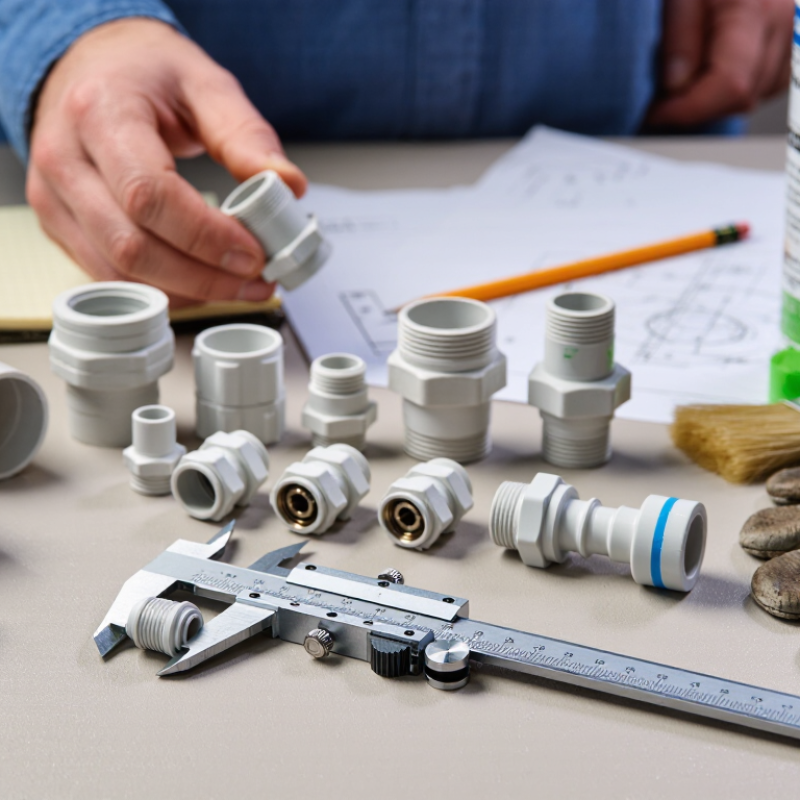
Choosing PVC pipe connectors starts with the project requirements, not the connector’s appearance. Measure the pipe’s actual diameter and confirm its pressure class. Nominal size can mislead. Also check the fluid, operating temperature, and expected flow rate. A connector suitable for cold water may fail in a warmer system.
Write down the working conditions before selecting elbows, tees, couplings, or unions. Pressurized lines need connectors rated above the system’s maximum pressure. Drainage systems need smooth flow, correct slope, and access for maintenance. Underground installations may require stronger joints and protection from soil movement. Solvent-welded joints offer a compact connection, while threaded or union connections allow easier removal. Choose carefully.
The layout matters as much as the material. Tight spaces may require compact fittings, but crowded bends can restrict access and increase installation errors. Dry-fit every section before applying cement. This simple step reveals alignment problems early. I have seen small measurement mistakes force an entire section to be rebuilt. That is frustrating, but it is also a useful reminder to verify twice.
Check the connector’s size, material compatibility, temperature range, and pressure rating. Follow the applicable installation instructions and local plumbing requirements. A connector can look correct and still be unsuitable for the actual service conditions. Keep that possibility in mind.
| Project Requirement | Recommended PVC Connector | Typical Application | Important Selection Criteria | Key Limitation or Caution |
|---|---|---|---|---|
| Join two pipes of the same nominal size | Straight coupling | Extending a straight pipe run or replacing a damaged section | Match the pipe nominal size, connection method, pressure rating, and PVC type | A standard coupling does not change pipe direction or size |
| Connect pipes with different nominal sizes | Reducing coupling or reducer bushing | Transitioning between branch lines, equipment ports, or different pipe sizes | Confirm both inlet and outlet sizes and verify the flow direction where applicable | A sudden reduction can increase flow velocity and pressure loss |
| Change the flow direction by 90° | 90-degree elbow | Routing water supply, irrigation, drainage, or process piping around obstacles | Choose a socket or threaded configuration and consider long-radius designs for lower resistance | Every elbow adds local pressure loss; avoid unnecessary bends in high-flow systems |
| Change the flow direction by 45° | 45-degree elbow | Creating a gradual offset or reducing the sharpness of a routing change | Check the available installation space and the required center-to-center dimensions | Two 45-degree elbows may require more space than one 90-degree elbow |
| Create one branch from a main line | Tee connector | Supplying a fixture, irrigation zone, filter, or secondary circuit | Select an equal tee or reducing tee according to the main and branch pipe sizes | The branch arrangement must support the intended flow rate and pressure |
| Connect two branches into one line | Wye connector | Drainage and waste systems where a more gradual branch entry is useful | Match the branch angle, pipe diameter, and drainage layout requirements | A wye is not interchangeable with every tee in systems requiring a specific flow path |
| Terminate a pipe run | End cap or plug | Closing an unused outlet, temporary test section, or future connection point | Use a solvent-weld cap for a permanent closure or a threaded plug where removal is required | Threaded connections need compatible threads and proper sealing practice |
| Connect PVC pipe to removable equipment | Union | Pumps, filters, valves, meters, and other components that may require maintenance | Check the pipe size, end connection type, seal design, and pressure-temperature rating | A union can simplify removal but should not be used to compensate for poor pipe support |
| Connect PVC pipe to metal equipment or a threaded port | Threaded adapter or socket-to-thread adapter | Connecting to tanks, valves, pumps, water heaters, or other threaded components | Verify male or female thread orientation, thread standard, size, and material compatibility | Avoid excessive tightening, which can damage plastic threads or create stress at the joint |
| Install a connector in a pressurized water system | Pressure-rated solvent-weld fitting | Cold-water distribution, irrigation, and other approved pressure applications | Match the fitting pressure rating to the system design pressure and operating temperature | Do not use drainage-grade fittings in pressure service; rating decreases as temperature rises |
| Build a gravity-flow drainage system | Drainage coupling, sanitary tee, or long-sweep fitting | Waste, vent, stormwater, and other non-pressurized drainage installations | Choose fittings designed for non-pressure service and maintain the required pipe slope | Drainage fittings are generally not intended for pressurized applications |
| Allow future access for inspection or cleaning | Cleanout adapter with threaded access plug | Drainage lines, underground runs, and locations prone to blockage | Position the cleanout where tools can reach it and leave adequate working clearance | The access opening must remain accessible after installation and landscaping |
| Install piping outdoors or underground | Fitting approved for the selected PVC pipe system | Buried water lines, irrigation networks, and exterior drainage | Consider soil loads, movement, ultraviolet exposure, temperature, and local installation requirements | PVC can become brittle with prolonged ultraviolet exposure; protect exposed pipe where required |
| Create a reliable solvent-weld joint | Socket fitting compatible with PVC solvent cement | Permanent connections in compatible PVC piping systems | Use the correct cement and primer where required; cut square, deburr, dry-fit, and fully insert the pipe | Joint preparation, cure time, ventilation, and temperature affect connection quality |
Measure the pipe’s actual outside diameter, not only its nominal size. Check pressure class, fluid type, temperature, and expected flow rate. A connector for cold water may fail in warmer service.
Use elbows for direction changes, tees for branches, and couplings for straight connections. Unions allow easier removal during repairs. Solvent-welded joints create compact connections.
Tight spaces may need compact fittings. Too many bends can restrict flow and maintenance access. Crowded layouts also increase alignment mistakes. Plan the route carefully.
Dry-fitting reveals gaps, poor alignment, and incorrect measurements before permanent joining. Check every section twice. A small error can force major rebuilding.
Clean and dry both surfaces thoroughly. Use compatible primer and cement. Push the fitting fully home with a slight twist. Hold it briefly, then allow complete curing.
Excessive tightening can split the fitting, especially in cold conditions. Apply suitable thread sealant away from the first thread. Tighten carefully. Force is not strength.
Support long pipe runs to reduce bending stress. Shield exposed PVC from prolonged sunlight. Drain the system before freezing weather. Underground joints may need protection from soil movement.
Inspect them every few months for whitening, distortion, seepage, or loose threads. Perform controlled pressure tests when appropriate. Record repairs, curing conditions, and test results. A dry joint may still weaken later.
Choosing the right Pvc Pipe Connectors begins with understanding your project’s purpose, layout, and operating conditions. Consider whether the system is designed for water supply, drainage, irrigation, ventilation, or another application, then select connector types such as elbows, tees, couplings, reducers, adapters, or unions to match the required flow direction and connection method. Accurate measurements are essential: confirm the pipe’s nominal size, outside diameter, wall thickness, shape, and compatibility with the connector. A properly matched fit helps prevent leaks, stress, and unnecessary installation difficulties.
Material quality, pressure rating, and temperature resistance should also be evaluated before purchase. Select connectors that can safely withstand the system’s working pressure and expected temperature range. During installation, cut pipes cleanly, remove burrs, align components carefully, and use an appropriate sealing method when needed. After assembly, inspect joints for movement or leakage and avoid excessive force that could damage the parts. Regular maintenance, including checking exposed connections and replacing worn seals, helps extend the service life and reliability of the entire piping system.
