 LANGLI PVC Request a Catalog LANGLI PVC Request a Catalog
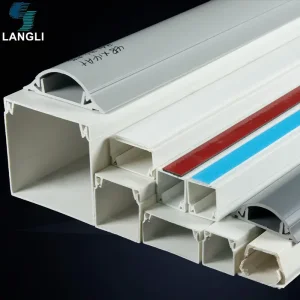
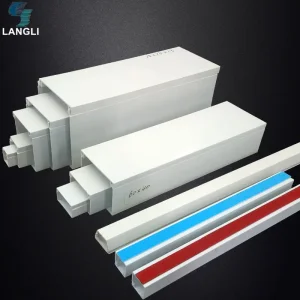
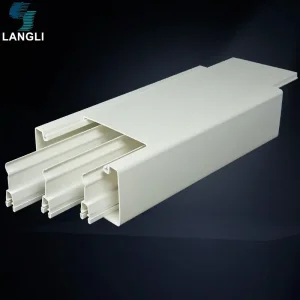
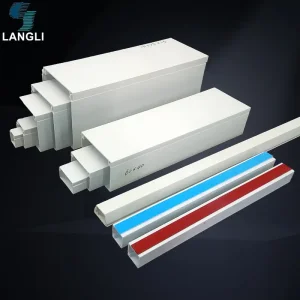
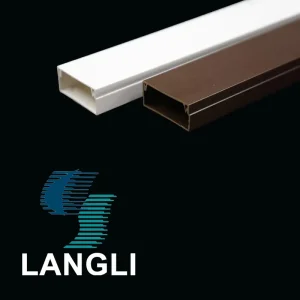
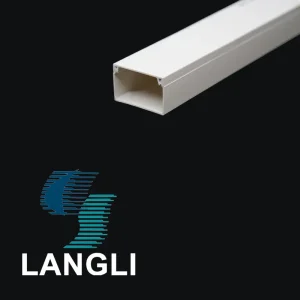
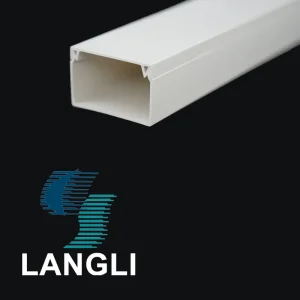
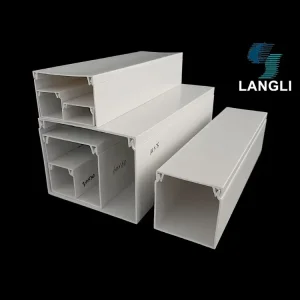
 Explore our high-performance rigid PVC trunking, wireways, and custom electrical enclosure components produced in our Foshan manufacturing hub.
A comprehensive technical analysis on unplasticized polyvinyl chloride (uPVC / Rigid PVC) slip tees, branch fittings, and socket systems for commercial, industrial, and electrical applications.
In modern industrial fluid management and electrical conduit infrastructure, PVC Slip Tees (commonly designated as socket-end equal or reducing tees) serve as the critical three-way junction component. Designed with unthreaded, smooth-bore sockets (Slip x Slip x Slip), these fittings facilitate rapid, leak-proof solvent weld connections that maintain fluid mechanical integrity under pressure.
Unlike threaded alternatives, a precision-molded PVC slip tee relies on chemical solvent fusion. When solvent cement is applied, the poly-resin layers of the pipe and fitting socket interpenetrate, creating a homogenous, monolithic joint that exhibits tensile strength equal to or exceeding the pipe body itself.
High-grade PVC slip tees manufactured in China utilize unplasticized Polyvinyl Chloride (uPVC) classified under ASTM D1784 Cell Class 12454 (Type I, Grade I). This ensures exceptional tensile strength (minimum 7,000 psi), high modulus of elasticity, and superior resistance to chemical degradation.
China leading factories produce PVC slip tees spanning imperial Schedule 40/80 and metric PN10/PN16 pressure classes. The table below outlines fundamental engineering tolerances:
| Parameter | Schedule 40 / Standard | Schedule 80 / Heavy Duty |
|---|---|---|
| Nominal Size Range | 1/2" to 12" (20mm - 315mm) | 1/2" to 8" (20mm - 200mm) |
| Working Pressure (23°C) | 150 PSI - 450 PSI | 230 PSI - 850 PSI |
| Joint Type | Solvent Cement Socket (Slip) | Heavy-Wall Solvent Socket |
| Applicable Standards | ASTM D2466 / ISO 1452-3 | ASTM D2467 / DIN 8063 |
Key technological, regulatory, and sustainability shifts driving the next decade of thermoplastic fitting design.
Global environmental regulations (REACH, RoHS 3, NSF/ANSI 61) have eliminated heavy metal heat stabilizers. Modern Chinese factories utilize advanced Calcium-Zinc (Ca-Zn) and Organic Based Stabilizers (OBS), guaranteeing zero toxic leaching in potable water and electrical applications.
Computational Fluid Dynamics (CFD) modeling is now integrated into mold design. By refining the internal branch radius of slip tees, Chinese engineers have reduced hydraulic turbulence and pressure drop coefficient (K-factor) by up to 18%, increasing overall pumping efficiency.
With cross-border sourcing growing rapidly, top-tier OEMs design slip tees capable of matching dual-standard specifications—enabling seamless transition between imperial ASTM D2466, DIN 8063, and British Standard BS 4607 conduit formats.
Understanding the critical decision drivers for international EPC contractors, municipal distributors, and OEM buyers when selecting China manufacturing partners.
| Risk Factor | Factory Benchmark Solution |
|---|---|
| Wall Thinning at Junctions | 3D Mold Flow Analysis & Multi-Gated Injection Tooling |
| Resin Thermal Degradation | Closed-Loop PID Temperature Controllers on Extruders |
| Solvent Joint Leakage | Precision Socket Taper Design following ASTM D2466 |
| Customs Compliance Delays | Pre-Issued CE, RoHS, and Form E/CO Documentation |
How advanced automation, localized raw material clusters, and high-speed injection technology give Chinese manufacturers an unassailable edge in scale, quality, and cost efficiency.
Centralized vacuum conveying systems blend virgin PVC resins, heat stabilizers, titanium dioxide UV-blockers, and impact modifiers with 0.1% accuracy, eliminating human mixing errors.
In-house CNC machining centers and EDM wire-cutting enable production of hardened S136 stainless steel molds rated for over 1,000,000 injection cycles with zero flash.
Automated optical inspection (AOI) cameras scan every molded slip tee branch directly on the robotic drop-belt, automatically ejecting parts with surface scratches, short shots, or dimensional warping.
Situated in Foshan, Guangdong, our factory leverages immediate access to South China major ports (Nansha, Yantian, Shekou), lowering container transit times and inland freight costs.
Selecting the optimal branch fitting based on system working pressure, mechanical load, removable requirements, and installation speed.
| Evaluation Feature | Solvent Weld PVC Slip Tee | Threaded Female/Male Tee | Compression Repair Tee | Saddle Clamp Branch |
|---|---|---|---|---|
| Joint Structural Integrity | Homogenous Fused Plastic (Highest) | Mechanical Thread Engagement | Rubber Elastomer Seal Friction | External Clamp Pressure |
| Pressure Rating | Up to PN16 / Sch 80 (Heavy Duty) | Medium (PN10 max due to stress concentration) | Low to Medium (PN6 - PN10) | Low Pressure / Drainage |
| Hydraulic Flow Efficiency | Smooth bore, minimal turbulence | Internal thread profile restriction | Internal wall step contraction | Branch hole intrusion drag |
| Permanent vs Removable | Permanent (Non-demountable) | Removable with wrenches | Fully Demountable | Semi-Permanent |
| Installation Skill Level | Standard Solvent Cementing Procedure | Requires PTFE Tape / Sealant torque control | Basic hand tools required | Hole saw cutting & bolt tightening |
From commercial high-rise electrical ducting to agricultural fertigation networks, see where China high-performance PVC slip tees excel.
Utilized as rigid electrical conduit branch fittings, flame-retardant PVC slip tees provide secure wire splitting points, protecting insulated conductors against mechanical chafing, moisture, and corrosive atmospheric agents inside concrete slabs or ceiling voids.
In high-tonnage HVAC installations, PVC slip tees connect individual air handler condensate drip pans into centralized collection risers. Smooth slip sockets prevent bio-sludge accumulation and blockage.
Modern greenhouse drip irrigation demands UV-resistant PVC branch fittings resistant to acidic fertilizer solutions, nitrates, and pest-control chemicals. High-density uPVC slip tees deliver zero-corrosion operations for decades.
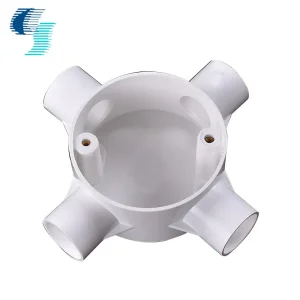
Complete your procurement package with our circular 4-way conduit boxes, decorative surface ducting, and custom PVC accessories.
Engineered installation steps to ensure zero-defect, pressure-rated joint integrity across commercial jobsites.
Cut pipe ends square using a ratcheting cutter or fine-tooth saw. Chamfer the outer pipe edge at a 10–15° angle and remove all internal burrs to prevent solvent cement scraping.
Verify dry-fit interference; pipe should enter the slip tee socket 1/3 to 2/3 of the way. Clean mating surfaces thoroughly with PVC Primer to soften resin walls.
Apply a full, even coat of heavy-bodied PVC solvent cement to the pipe exterior, followed by a thin coat inside the slip tee socket without pooling.
Immediately push pipe fully into the tee socket while giving a 1/4 turn to evenly distribute cement. Hold firmly for 30 seconds. Allow proper curing before hydro-testing.
Expert technical answers directly from our factory engineering director and international trade team.
Request full technical datasheets, CAD mold drawings, or an instant factory FOB/CIF price quotation from our export engineering desk.