 LANGLI PVC Request a Catalog LANGLI PVC Request a Catalog
 Explore our export-grade rigid conduit pipes, multi-size wireways, and custom accessories manufactured under ISO 9001 and certified to CE & RoHS international safety benchmarks.
Understanding the critical structural metrics, thermal dynamics, and mechanical performance required for commercial, industrial, and infrastructure power distribution systems.
The 1.25-inch (nominal trade size 1-1/4" / 32mm - 42.16mm outer diameter) PVC conduit serves as the primary conduit threshold bridging light branch circuits to heavy feeder distribution lines. It offers optimized wire-fill density under National Electrical Code (NEC) guidelines, preventing heat accumulation during continuous ampacity loads.
Unplasticized Polyvinyl Chloride (PVC-U) engineered for 1.25" electrical raceways exhibits exceptional dielectric strength (>25 kV/mm), mitigating electrical leakage and flashover risks. The formulation incorporates heat-stabilizing organotin or calcium-zinc complexes, ensuring structural integrity up to 75°C continuous operating temperatures.
Unlike rigid metallic conduit (RMC) or intermediate metal conduit (IMC), 1.25 PVC conduit is immune to electrochemical soil corrosion, galvanic degradation, and moisture oxidation. This makes it the standard raceway material for direct burial, wet location slab pours, and chemically aggressive industrial plants.
| Specification Metric | 1.25" Schedule 40 PVC Conduit | 1.25" Schedule 80 PVC Conduit | 32mm Heavy Gauge (BS EN 61386) | Test Standard Compliance |
|---|---|---|---|---|
| Outer Diameter (OD) | 1.660 in (42.16 mm) | 1.660 in (42.16 mm) | 32.00 mm (+0.0 / -0.3 mm) | ASTM D1785 / BS 4607 |
| Min. Wall Thickness | 0.140 in (3.56 mm) | 0.191 in (4.85 mm) | 2.40 mm Nominal | UL 651 / IEC 61386-21 |
| Inside Diameter (ID) | 1.380 in (35.05 mm) | 1.278 in (32.46 mm) | 27.20 mm Nominal | Calculated Dimensional Analysis |
| Approx. Weight per Meter | 0.68 kg/m | 0.89 kg/m | 0.48 kg/m | ISO 1183 Specific Gravity |
| Max Wire Fill (40% THHN) | 6 Wires (#4 AWG) | 5 Wires (#4 AWG) | N/A (Metric Standard Metric Wire) | NEC Chapter 9, Table 1 |
| Impact Resistance Class | Medium Impact (6 Joules) | Heavy Impact (15 Joules) | Class 4 Heavy (6 Joules at -15°C) | UL 651 / EN 61386 Drop Test |
| Recommended Installation | Direct Burial / Encased / Exposed | High Traffic / Physical Abuse Areas | Surface Mounted / Flush Commercial | NEMA TC-2 / BS installation Code |
When engineering multi-conductor feeder circuits, maintaining the 40% maximum wire fill capacity threshold specified in NEC Chapter 9 is mandatory to prevent thermal derating. A 1.25 Schedule 40 conduit provides an internal cross-sectional area of approximately 1.495 sq. in. (965 sq. mm), allowing optimal pull-tension for three 2/0 THHN conductors or up to sixteen #10 AWG branch wires without exceeding pull force tolerances or inducing skin-effect heating.
How modern extrusion technology, local raw material supply chain integration, and precision quality engineering give Foshan Shunde Langli Hardware Electrical PVC Co., Ltd. a superior global advantage.
Situated in Shunde, Foshan—the world's densest plastics manufacturing cluster—our facility leverages direct pipeline access to high-purity virgin PVC-U resin (K-value 67-68). This eliminates raw material transport surcharges, allowing us to deliver premium-grade flame-retardant 1.25 PVC conduit at factory-direct unit economics.
We utilize high-speed twin-screw extruders equipped with continuous laser wall-thickness ultrasonic sensors and gravimetric dosing systems. This ensures zero wall eccentricity across 100% of our 1.25 PVC conduit output, guaranteeing seamless solvent-weld socket fitting every time.
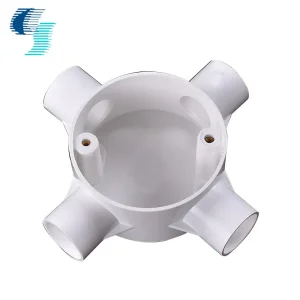
With over 900 sets of precision injection moulds and 32 heavy injection machines on site, we tool match-fit 1.25 inch couplers, elbows, tees, inspection bends, and junction boxes in-house, eliminating third-party supplier tolerance stack-up issues.
As electrical infrastructure becomes smarter, greener, and more strictly regulated, PVC conduit engineering is evolving rapidly toward zero-halogen compounds, automated installation designs, and circular lifecycle materials.
Traditional PVC additives are undergoing a global transition toward heavy-metal-free, lead-stabilized alternatives. Green building codes (LEED, BREEAM) and European EN 50642 regulations require 1.25 PVC conduit installed in public transit, hospitals, and high-density residential towers to utilize halogen-free or ultra-low toxicity flame retardants that generate minimal corrosive smoke under thermal fire degradation.
Modern electrical contractors require rapid visual circuit identification. Manufacturers are moving toward multi-layer co-extrusion technology, where a 1.25 PVC conduit features an outer wear-resistant layer with color-coded stripes (e.g., Orange for High Voltage, Blue for Telecom/Data, Yellow for Solar PV) and a high-lubricity white inner lining designed to cut wire friction coefficients by up to 30%.
With the explosive growth of commercial solar PV arrays and EV charging networks, 1.25 inch conduit is increasingly exposed to direct solar radiation and extreme outdoor temperature swings. Advanced compounding incorporates nano-titanium dioxide (TiO2) and hindered amine light stabilizers (HALS) to prevent polymer chain scission, discoloration, and embrittlement under intense UV exposure.
Off-site modular construction is revolutionizing building techniques. 1.25 PVC conduit systems are increasingly designed with standardized belled sockets and snap-fit modular connectors that integrate directly into Building Information Modeling (BIM) software, allowing precise off-site pre-cutting, pre-bending, and rapid site assembly.
How standard 1-1/4" trade size piping provides optimal mechanical protection across commercial, industrial, residential, and agricultural infrastructure environments.
In multi-story office buildings and commercial complexes, 1.25 PVC conduit is widely used inside vertical electrical shafts to house main floor branch feeds from central distribution switchboards, offering excellent rigidity and fire-stop compatibility through concrete floor slabs.
Where airborne chemical fumes, severe washdowns, or organic acids degrade galvanized metallic conduits, Schedule 80 1.25 PVC conduit provides total immunity to chemical degradation in processing lines, bottling facilities, and wastewater treatment plants.
Hyperscale server facilities deploy 1.25 PVC conduits underground or under raised access flooring to route high-density fiber optic trunk cables and sub-feeder power distribution lines requiring non-magnetic, zero-electromagnetic-interference pathways.
Tailored OEM/ODM raceway solutions for large-scale utility projects, transport infrastructure, and municipal renewable power grids.
Large-scale solar installations require miles of underground DC string cable routing from combiner boxes to central inverters. Our custom UV-stabilized 1.25 PVC conduit features heavy-duty direct-burial rating (Schedule 40/80 and ASTM D1785 certified). The solvent-weld bell ends ensure watertight joints that withstand high soil compaction, moisture immersion, and thermal expansion/contraction cycles without joint separation.
Deploying Level 3 DC fast-charging stations along highway corridors demands high-ampacity feeder cables run under asphalt and concrete parking structures. Custom 1.25 PVC conduit acts as a flexible, high-impact mechanical barrier preventing shear damage from heavy vehicle traffic while simplifying long cable pulls with reduced wire friction.
Transportation authorities mandate low-smoke, non-toxic raceway materials inside subterranean tunnels. Langli’s engineering team produces specialized Low-Smoke Zero-Halogen (LSZH) 1.25 PVC conduit variants engineered to meet stringent EN 45545-2 and NFPA 130 fire protection standards, protecting passengers during emergency egress situations.
Coastal infrastructure faces relentless salt spray, humidity, and coastal air salinity. Metal conduits suffer pinhole corrosion and structural failure within months. Langli's solid-wall rigid 1.25 PVC conduit systems provide decades of zero-maintenance lifecycle performance for salt-crusting coastal pumps and marine electrical networks.
How we satisfy international buyer compliance, private-label packaging requirements, bulk container loading optimization, and global logistics standards.
Whether your market demands Schedule 40 (NEMA TC-2 / UL 651), Schedule 80, BS EN 61386-21 (32mm), or Australian standard AS/NZS 2053, we adjust wall thickness, socket length, bell-end tolerances, and length cuts (typically 2.9m, 3.0m, or 5.8m for optimal 20ft/40ft container fit) to match local electrical codes.
We provide continuous high-resolution inkjet or laser brand printing directly along the outer wall of every 1.25 PVC conduit tube. Custom text options include your brand name, trade size, material standard, fire rating, manufacturing lot number, and customized barcode sequence for streamlined distribution inventory management.
To reduce ocean freight costs for international distributors, our shipping team utilizes advanced nesting algorithms—packing smaller conduit diameters (e.g., 16mm, 20mm, 1/2", 3/4") inside 1.25" and 2" conduits. This maximizes container volumetric fill efficiency, lowering landed shipping cost per meter by up to 28%.
Authoritative technical, regulatory, and logistics answers compiled by Langli’s senior export engineering desk.
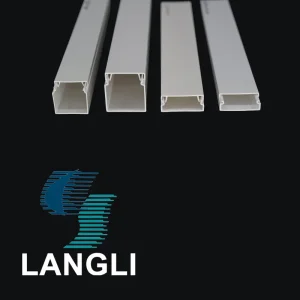
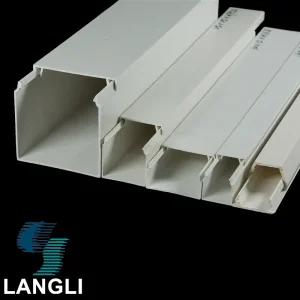
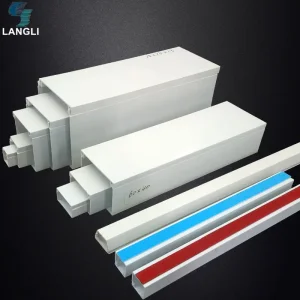
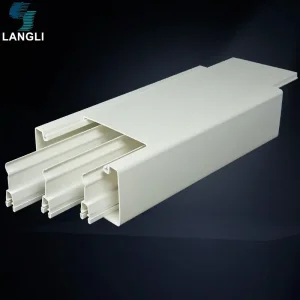
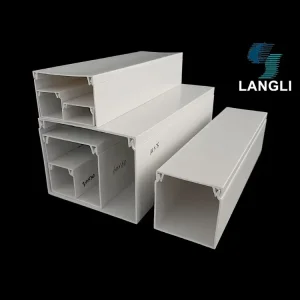
Complete your procurement package with our extended collection of wireways, air ducting, and heavy-duty electrical fittings engineered to standard tolerances.