 LANGLI PVC Request a Catalog LANGLI PVC Request a Catalog
 Direct-from-factory electrical containment systems designed for severe weather resistance, UV stability, and rapid site installation.
Modern rooftop environments present some of the most aggressive degradation vectors for electrical infrastructure. Rooftop installations are constantly subjected to extreme thermal cycles, severe ultraviolet radiation, high wind loads, structural expansion, and chemically aggressive ambient environments. As global commercial and industrial sectors scale their rooftop solar Photovoltaic (PV) deployments and HVAC infrastructure, selecting high-performance, non-metallic roof conduit solutions from qualified roof conduit manufacturers & suppliers has transitioned from a routine procurement decision to a critical engineering priority.
Commercial rooftop solar arrays require high-capacity, flame-retardant DC wireways capable of operating continuously at elevated ambient temperatures without structural sagging or dielectric breakdown.
Traditional rigid conduit degrades rapidly under continuous solar irradiance. Next-generation UPVC roof conduits integrate specialized Titanium Dioxide (TiO2) and carbon black inhibitors to block photochemical degradation.
Rooftop temperature variations exceeding 50°C daily demand engineered expansion fittings and low-coefficient polymer compounds to prevent buckling, joint separation, and water ingress.
Regional electrical codes and climate pressures drive distinct engineering demands across international markets. Understanding these localized requirements allows leading roof conduit suppliers to customize polymer formulations, wall thicknesses, and connection mechanisms.
In North America, compliance with National Electrical Code (NEC) Article 352 for Rigid Polyvinyl Chloride Conduit (Type PVC) is mandatory. Rooftop solar contractors require schedule 40 and schedule 80 wall dimensions capable of enduring freezing snow loads and intense summer heat waves. Thermal expansion sleeves and UV resistance certifications (UL 746C) are essential for project approval.
European logistics hubs and industrial facilities prioritize low-smoke, zero-halogen (LSZH) and self-extinguishing UPVC trunking systems conforming to BS EN 61386 and BS 4607. Smooth internal wireways, tight snap-on lid retention, and chemical resistance against atmospheric pollutants are critical parameters for commercial rooftop infrastructure.
The Gulf Cooperation Council (GCC) regions and Asia-Pacific industrial parks present severe ambient operating temperatures often exceeding 50°C, alongside high dust and sandstorm exposure. Procurement directors in these regions require heavy-duty impact resistance (Class 5 impact rating) and specialized high-Vicat softening temperature compounds to prevent roof conduit sagging.
As global supply chains place an increasing premium on resilience, efficiency, and strict quality control, Foshan Shunde Langli Hardware Electrical PVC Co., Ltd. stands at the forefront of advanced polymer extrusion and injection moulding. Founded in 1989, Langli’s automated manufacturing ecosystem in Guangdong, China delivers unequaled cost efficiency and technical repeatability.
Equipped with 32 state-of-the-art injection moulding machines and an automated central feeding resin facility, Langli eliminates human batching error. Every compound batch is precisely metered with specialized heat stabilizers, impact modifiers, and UV absorbers to produce homogenous conduit walls with flawless tensile performance.
With an extensive tooling library exceeding 900 custom mould sets, Langli provides rapid prototyping and custom dimension production for specialized roof conduit profiles, circular junction boxes, and cable trunking. Private labeling, custom color matching (Pantone/RAL), and specialized carton printing are seamlessly integrated into production lines.
| Performance Metric | Langli High-Spec UPVC Conduit | Standard Commercial PVC Pipe | Galvanized Steel Metallic Conduit |
|---|---|---|---|
| UV & Weathering Resistance | High (5% TiO2 UV Stabilized) | Moderate (Degrades in 12-24 mos) | High (Subject to surface rust) |
| Corrosion Resistance (Salt/Acid) | 100% Corrosion Proof | High Corrosion Resistance | Low-Moderate (Rusts at joints) |
| Flame Retardancy Standard | UL 94 V-0 Self-Extinguishing | V-2 or Non-rated | Non-combustible |
| Vicat Softening Temperature | > 82°C (180°F) | < 70°C (158°F) | N/A (> 1000°C) |
| Installed Total Cost of Ownership | Lowest (Fast snap-fit assembly) | Low initial cost, high failure rate | Very High (Heavy labor & tools) |
Proper field performance requires matching specific electrical cable containment products with the environmental stresses of each rooftop deployment scenario.
Challenge: Routing high-voltage DC string cables across vast membrane roofs with direct solar exposure and standing water potential.
Solution: Heavy-gauge UV-stabilized UPVC trunking with self-adhesive rubber bases or elevated ballast clips. Smooth internal raceways eliminate insulation abrasion during long cable pulls.
Challenge: Severe mechanical vibration from compressor units and heavy chemical exposure from cooling tower water treatments.
Solution: Flexible chemical-resistant UPVC conduit paired with IP68 circular junction boxes. Elastomeric gasket seals prevent vibration loosening and liquid ingress into electrical connections.
Challenge: Managing complex fiber optic and power feeds on elevated equipment platforms subject to intense wind load shear.
Solution: High-impact rigid PVC trunking featuring dual-locking lids. The snap-fit cover remains firmly locked under wind speeds exceeding 160 km/h, securing sensitive data infrastructure.
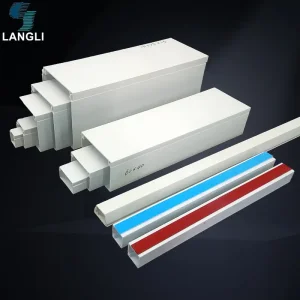
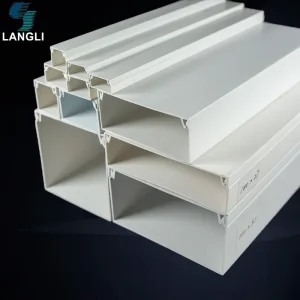
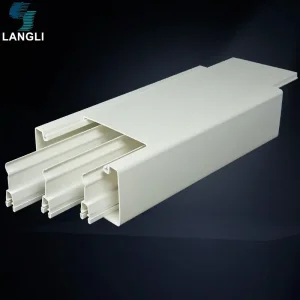
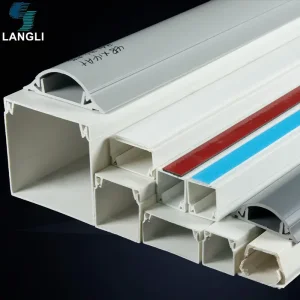
Explore our extended range of customized wire ducts, TV trunking, and high-impact electrical cable pathways available for bulk global delivery.
Direct answers regarding technical standards, manufacturing lead times, custom OEM tooling, and quality assurance from Langli's export department.