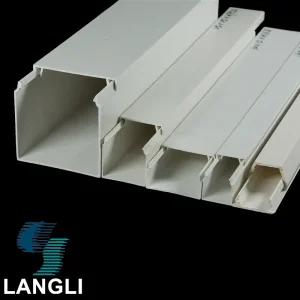
 LANGLI PVC Request a Catalog LANGLI PVC Request a Catalog
 Factory-direct wholesale solutions certified to international standards for structural containment, high thermal rating, and flame retardancy.
In modern structural architecture, vertical electrical pathways—commonly known as vertical utility risers, cable shafts, and core service chases—represent the central neural backbone of high-rise commercial towers, multi-tenant residential complexes, hyper-scale cloud data centers, and heavy industrial facilities. Designing and manufacturing conduit systems engineered specifically for vertical runs involves solving fundamental mechanical challenges distinct from horizontal tray or underfloor installations.
Unlike horizontal wiring pathways where cable mass is evenly distributed across continuous structural supports, vertical cable containment must endure relentless tensile loads caused by gravity acting upon heavy electrical conductors. Unmitigated vertical gravitational pull leads to conductor creep, insulation deformation, shearing at junction points, and eventual electrical faulting. Furthermore, long-run vertical conduit shafts act as mechanical chimneys, presenting severe chimney-effect thermal drafts and fire-propagation vectors during thermal events.
A critical consideration for MEP (Mechanical, Electrical, and Plumbing) consulting engineers is the Linear Coefficient of Thermal Expansion (CLTE). Rigid uPVC conduits exhibit a thermal expansion rate of approximately $6.0 \times 10^{-5} \text{ / } ^\circ\text{C}$. In tall structural shafts where operational temperatures fluctuate between ambient building states and full conductor load states (reaching $75^\circ\text{C}$ to $90^\circ\text{C}$ inside enclosed raceways), a 30-meter vertical rise can expand or contract up to 90mm.
To prevent structural buckling, pop-out fitting separation, or mechanical shear on mounting anchors, precision vertical conduit systems utilize slip-expansion couplers, intermediate strain-relief clamps (strain-box assemblies), and anti-vibration rubber gaskets engineered into every fitting interface.
Integrated internal clamping ribs distribute conductor load across the conduit body, eliminating insulation shear at upper strain boxes.
Engineered slip-expansion joints allow up to 100mm linear displacement per 30m vertical run without compromising IP65 sealing.
High-purity uPVC formulation delivers breakdown voltage strength >40 kV/mm, insulating high-density power feeders against arching.
Compatible with intumescent fire-stop collars, maintaining floor-to-floor fire compartmentation up to 4 hours (EN 1366-3).
Enterprise procurement officers, Tier-1 EPC contractors, and global electrical distributors must evaluate wholesale vertical conduit manufacturers against a stringent array of international standards, material properties, and quality control metrics. A failure in raw material formulation or dimensional tolerance can result in catastrophic site delays, regulatory rejection, or in-service thermal breakdown.
| Performance Parameter | Standard / Test Method | Standard Wholesale Grade | Industrial High-Spec Vertical Grade |
|---|---|---|---|
| Raw Polymer Base | ASTM D1784 / ISO 182-3 | Virgin uPVC (K-67 Resin) | Reinforced High-Impact uPVC Blend |
| Flammability Class | UL 94 / IEC 60695-11-10 | V-1 Self-Extinguishing | UL 94 V-0 (Extinguishes within 10s) |
| Impact Strength (Izod) | ISO 180 / ASTM D256 | > 5 kJ/m² at 23°C | > 12 kJ/m² at -15°C (Cold-impact resilient) |
| Tensile Strength at Yield | ISO 527 / ASTM D638 | 40 - 45 MPa | 52 - 58 MPa (High vertical load capability) |
| Vicat Softening Point | ISO 306 / ASTM D1525 | ≥ 78°C | ≥ 86°C (High thermal environment retention) |
| International Compliance | Directives & Codes | CE, RoHS 2.0 | BS EN 61386-21, IEC 61386, REACH, CE, RoHS |
| Ingress Protection (IP Rating) | IEC 60529 / EN 60529 | IP40 - IP54 | IP65 - IP68 (With solvent-weld / O-ring seal) |
The longevity of vertical uPVC trunking and conduit stems directly from compounding chemistry. Lower-tier manufacturers often load PVC resins with excess calcium carbonate ($\text{CaCO}_3$) filler (exceeding 20%), which severely degrades impact resistance and causes the conduit to become brittle over time. Precision manufacturing at our Foshan facility utilizes a micro-balanced formulation: K-67 medical/industrial grade virgin resin, organic tin or calcium-zinc (Ca/Zn) eco-stabilizers, CPE (Chlorinated Polyethylene) impact modifiers, and rutile-grade titanium dioxide ($\text{TiO}_2$) for superior UV stability.
Tailored conduit containment engineering designed to solve domain-specific challenges across critical global industries.
Hyperscale facilities require massive vertical busway cabling and fiber optic drops. Our anti-static, smooth-bore uPVC trunking prevents cable jacket abrasion during high-density pulls, while electromagnetic shielding compatibility guarantees zero sign crosstalk.
Commercial and residential towers demand rigorous fire compartmentation. Our vertical conduit system seamlessly integrates with EN 1366-3/UL 1479 intumescent fire collars, expanding during fire events to seal off shaft penetrations against smoke and flame migration.
Utility-scale commercial solar installs route DC wiring down building facades to ground inverters. Featuring ASTM G154 UV-stabilized compounding, our conduit withstands 5000+ hours of accelerated solar radiation without discoloration or cracking.
Corrosive industrial environments rapidly degrade metal galvanized conduit. Our rigid uPVC trunking is 100% resistant to acids, alkalis, salts, and moisture, delivering an uncompromised 30-year operational life in harsh chemical facilities.
Located in Foshan, Guangdong—the core global manufacturing epicenter for electrical accessories and plastic polymer engineering—Foshan Shunde Langli Hardware Electrical PVC Co., Ltd. operates a high-capacity Industry 4.0 production facility. Combining automated raw-material dosing systems, 32 high-tonnage precision injection molding presses, and continuous extrusion lines, our factory achieves exceptional structural consistency across large-volume wholesale orders.
Complete in-house mold tooling facility capable of producing custom profile geometries, localized standard fittings (BS, DIN, ASTM), and private-label embossing within 30 days.
Inline dual-axis laser calipers continuously monitor extrusions, guaranteeing wall thickness tolerance within ±0.05mm across 100% of production runs to prevent weak wall spots.
Computerized resin blenders ensure exact dosing of flame retardants, UV stabilizers, and color pigments, eliminating batch-to-batch structural or aesthetic variance.
Global buyers encounter severe supply chain friction when dealing with fragmented vendors who supply pipes from one source and fittings from another. Mismatched socket tolerances lead to loose fits, adhesive breakdown, or physical installation failures on site. By manufacturing conduit pipes, trunking bodies, junction boxes, and matching fittings in a unified single-site facility, we ensure 100% mechanical socket alignment.
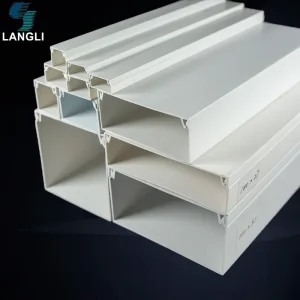
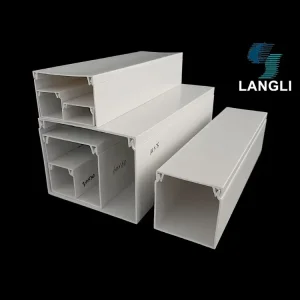
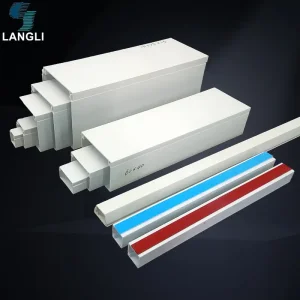
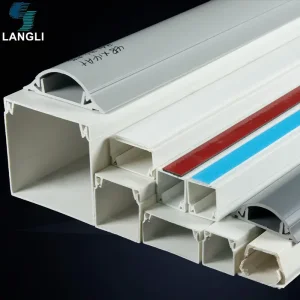
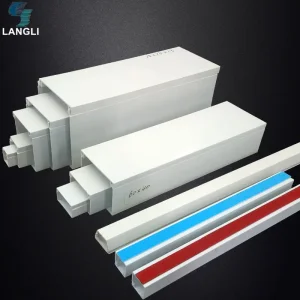
Furthermore, our logistics engineering team maximizes shipping container utilization (CBM optimization). By nesting smaller trunking sizes inside larger profiles (e.g., placing 16x16mm inside 40x40mm and 100x50mm channels), we reduce ocean freight costs per unit by up to 35%, granting electrical wholesalers a distinct pricing advantage in their domestic markets.
As building automation, 5G smart risers, and decarbonization mandates reshape modern infrastructure, electrical raceways are evolving from passive mechanical channels into intelligent, sustainable containment ecosystems. Our R&D division is driving innovations across three core pillars:
Integrating bio-based ethylene feedstocks sourced from certified forestry waste, reducing the carbon footprint of uPVC conduit by up to 45% while retaining 100% mechanical strength and UL94 V-0 flame ratings.
Developing conduit profiles pre-molded with linear thermal sensing channels, allowing integrated fiber-optic temperature sensors to continuously monitor high-voltage vertical cables for thermal hotspots.
Next-gen push-fit trunking fittings and vertical snap-couplers designed to slash onsite installation time by 60%, eliminating the need for chemical solvent welds in sensitive indoor air environments.
Navigating regional electrical standards requires more than off-the-shelf product catalog offering. We work closely with international engineering consultants, municipal infrastructure authorities, and commercial distributors across the Middle East, Europe, Southeast Asia, South America, and Africa to ensure full regulatory alignment.
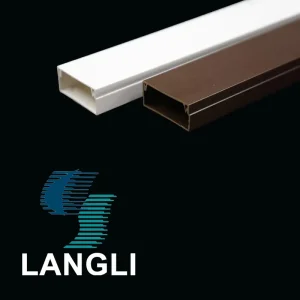
Whether your market requires specific color coding (e.g., high-visibility orange for telecommunication vertical drops, crisp architectural white for exposed residential runs, or jet black for industrial plants), custom length cuts (2.9m, 3.0m, or 5.8m for container fitting), or laser-etched custom logos and part numbers, our OEM services support complete private labeling with minimal lead times.
Expert insights addressing key procurement, engineering, and installation queries from project contractors and wholesalers.
Explore our additional factory-direct UPVC cable trunking, wire ducting, and custom size electrical containment systems.